Tuesday, December 7, 2010

musings of the afternoon: armies of tortoises

Today Joshua and I went grocery shopping. We have determined the best time to go is anywhere from 2:00 or 4:00 in the afternoon. It is only then you can be certain it will be the least bustling. The mall smelled wonderful though, the roasted almond smell is the only part of christmas shopping I enjoy.
Weird thing though, there seemed to be some sort of preschool on a field trip at the mall. There were dozens of them all over the food court area. Armies of them crowding the Panda Express. It reminded me of a conversation I had with my sister once. Andrea theorized that an army of anything is scary; anything. I thought about it for awhile, longer than I should have to be honest. I don't think an army of Galapagos tortoises would be threatening. They just slowly amble forward...
 Beware our slowly impending doom. DOOM!

I am far too easily distracted. I challenge Andrea's theory.

Monday, December 6, 2010

knitting

Sometime last year my friends Amanda and Emily taught me how to knit. This was...frustrating in the beginning. I sort of cheated and ended up going to youtube knitting channels to watch videos of others knitting to figure it out better. I could have never been amish; I have a potty mouth and a tendency to give up when I get overly frustrated. In fact, I got so annoyed with trying to learn to purl stitch I threw the piece I was working on at my kitten and didn't pick up knitting again for nearly 4 months.
In fact, I drew a comic of said event.
See the frustration on my face?
So far I have knitted 3 successful scarves. I am working on a blanket now. But honestly, I should really be doing homework instead.

So..back to that. Back to drawing naked men. Ugh.

christine


I intended for this to be the 4th post about my eating disorders study and disclosure, but I have determined my own  theory needs more development. So it will have to wait...though I doubt anyone will be upset by this delay. 
So, instead of psychology you get:

This is Christine. She is the bee's knees. She is the only reason to keep me from wanting to move to Portland, OR. Too far away.
Yes, this is just a post about my friend Christine. She likes avocados, Caitlin's cat doesn't like her much for some reason, she also likes pomegranates and cheez its. 
She also constantly craves chewy chocolate chip cookies. We became friends nearly 2 years ago when her and Trey broke up. This ended up being fairly beneficial for me in the friend's department. Now I have 3 close female companions (she's the best though). This is a big deal.
I knitted her a scarf for part of her christmas present, but now I am displeased with it now that I have finally mastered the purl stitch. I will make her better things. It is my goal that over the course of our entire friendship I fill an entire closet in her future house of knitted things. You know, the kind that is so full that she has to be careful opening the door as to avoid an avalanche of knits that will leave her buried in the hallway - I can see it now; her little hands sticking out from under a monstrous pile of yarn and thread reaching hopelessly for freedom. She will end up with many many scarves and blankets, those are the only things I can do really well so far.
In my head I imagine she speaks spanish to random objects about her house, I don't know why. I think I dreamt it once.

Saturday, December 4, 2010

disorders-shmismorders: part 3

Peggy Claude-Pierre cites CNC as the sole cause for eating disorders, but on this one point I have to disagree. Sometimes it's hard to maintain a healthy body weight and be happy with your body with certain images floating around in the media. The diet and fashion industries can have huge influences on many individuals. And with the recent rise in the awareness of eating disorders it has had both positive and negative effects. The high profile of eating disorders in both academic and popular press suggest a cultural fascination with eating disorders. This tells us that not only does it have an impact on the individual level but is also of a wider cultural relevance. It is beginning to be recognized as a 'culture-bound; syndrome.
When it comes to women and gender, a lot of the issues can stem from how we view femininity. Eating disorders can be viewed as a manifestation of socio-cultural concerns of the late 20th century concerns about femininity and feminism, about the body, and about control. But an eating disorder can result in the loss of femininity in some women.
Obviously the most basic indicators of the female form are a curvaceous torso, breasts, and just overall a shapely figure. When eating disorders become so serious that the individual's weight spirals into the lower double digits she ceases to maintain her feminine figure. So is the strive to be feminine a legitimate reason? Maybe, another indicator of femininity is delicateness and lightness. The smaller you get the more delicate and graceful you appear. That was certainly a draw for me.
Women will get smaller and smaller, comparing themselves to the women on the television, movies, magazines, etc. You can tell me or anyone else over and over again how small we are, how nice our bodies are...but you have to realize in the mind of an anorexic or any other type there is no objectivity; just subjectivity. They tend to lack an identity and view the world as if it is some sort of twisted fantasy.
And don't even get me started on the paranoia that you are trying to make us fat. I remember being convinced my boyfriend was trying to get me to gain weight because...no logical reason.
But back to the focus on eating disorders in the media. Back in 2006 a fashion model named Ana Carolina Reston died due to complications from anorexia nervosa. She had a diet consisiting only of apples and tomatoes and had a BMI of only 13.4, below the index value of 16. Which is, according the the World Health Organization, is considered to be starvation. She died at age 22. She is pictured above and to the right.
Another model died earlier that same year. Her name was Luisel Ramos, she was also 22. She died of heart failure caused by anorexia nervosa. The three months before her death she ate only lettuce and diet coke, according to her father. And at the time of her death she had a BMI of only 14.5, weighing 97lbs. And just a year later her younger sister succumbed to the same fate; suffering from a heart attack caused by malnutrition.
In the news we read all about this, but we still seem to lack proper awareness. I don't ever remember ever going over eating disorders in any of my health or biology classes. And it was hardly touched on in my high school psych classes. If anything we should be educating ever younger girls about the dangers of this and getting them to be more in tune and happy with their bodies. Teach them how to be healthy. Just recently I watch a documentary about a girl who was only 8 years old, and she had anorexia so severely she had to be placed in a treatment facility.
So is this just CNC? I think it seems to be a combination of both CNC and outside forces. But is there still more going on? Are there still other factors? In the next post on this topic I will address a theory of my own I have been toying with.


sources:
The Thin Woman by Helen Malson
The Secret Language of Eating Disorders by Peggy Claude-Pierre

Friday, December 3, 2010

disorders-shmismorders: part 2

As said in the first post there are many theories as to why an individual may develop an eating disorder. The one I tend to adhere to the most is a theory developed and coined by Peggy Claude-Pierre. This is CNC - Confirmed Negativity Condition. She says that this disorder is the underlying cause, it is a complex thought process that plagues the mind. In fact, the eating disorder is to CNC what a rash is to the measles. It's a symptom, but not meant to minimize the severity of an eating disorder.
I suppose the best way to explain CNC is like a civil war within the mind. The predisposition for CNC begins early in life, though just because one might have CNC does not mean one will develop and eating disorder. Keep that in mind. Other manifestations from CNC can include depression, agoraphobia, panic attacks, obsessive-compulsive disorder, or somatic disorders. An individual can have any or more of these manifestations without actually having an eating disorder. But some can often coexist with an eating disorder. An example of that might include being very agoraphobic and being anorexic. Also, when healing from an eating disorder one might replace said disorder with another manifestation.
CNC tends to precede the disorder and is the root of it. It is like a parasite that attempts to consume all rational thought. She calls us and our rationality the Actual Mind. Milton said it best in Paradise Lost:
       "The mind is it's own place, and in itself,
        Can make a heaven of hell, and a hell of heaven."
But there is much more to understanding CNC. In order to getting into the mind of someone with CNC you must realize that certain types of people are far more susceptible to to the "negative mind" than others. The people that are most at risk are the ones who are essentially altruistic and does not want to be a burden on her family or society by reaching out for aid. Moreover, victims of CNC tend to assume they are not wanted, they feel unworthy and feel like they are being excluded from things because they are any negative adjective they can think of.  
I have tried to explain CNC before and it never comes out sounding right. Some don't quite understand. It's as if there is a voice in your head always telling you that you are fat, worthless, pathetic, etc. And the voice is relentless; beating down on you almost every minute. Even now whenever I eat I need to be watching or doing something in order to distract myself and the negative thoughts from what I am doing. But the sad thing is that I shouldn't need to distract myself. And this is how a lot of eating disorder sufferers go through.
A big part of what some people with eating disorders do is collect "thinspiration". This is basically a book or folder full of photographs, quotes, or "dieting" tips, as well as other little tricks to prevent weight gain and encourage weight loss. Here are some examples from my former thinspiration notebook:
       1. Eat on a blue or black plate since darker colors make you feel full faster.
       2. Always wear a rubber band around your wrist and snap it when you feel hungry.
       3. Chew sugar free gum whenever you feel hungry, but don't eat too many as they are about 5 calories per piece.
       4. When craving something make a list of why you shouldn't eat it and read it over 20 times or so. The craving will pass in about 20 minutes.
       5. Make a meal plan to limit your food intake.
       6. Look at supermodels and other thin people to remind yourself what you want to look like.
       7. Move as much as possible! Exercise whenever you can.
       8. Pinch your fat. Always remember there is something to lose.
These are just some of the many crazy things I wrote down to keep my weight down. Anna Faris was a body type I emulated a great deal. I'm watching a movie starring her right now and it's hard not to compare myself and feel down. At the height of my disorder in high school, my senior year to be exact, there was one book that helped me identify. It is you remind me of you by Eireann Corrigan. It is a poetry memoir about a girl who has an eating disorder and all the other issues of her life that impacted her. There is a particularly powerful scene, it reminded me of my father and something he might do had he known;
     After I fell asleep doing sit-ups on the family room,
     floor, he carried me upstairs to my bed and he must have been
    cursing you the whole heavy trip. And later 
    when they caught me hiding food, when my mom
    would stand behind me on the scale and cry at the numbers --
    Those mornings, when I would bundle up at five to run
    he'd creep behind me in the station wagon in case I fell
    and didn't get back up. Sometimes I'd make it 
    home just to faint in the shower and my dad had to 
    listen for that tumble and rush in to swing the faucet
    from hot to cold.
This is just one of the many excerpts from the very moving book. I suggest anyone with eating disorder issues read this.        

But CNC is just part of the problem for people with eating disorders. There are still other factors to discuss. to be continued....


sources:
The Secret Language of Eating Disorders by Peggy Claude-Pierre
The Thin Woman by Helen Mason
The Eating Disorder Sourcebook by Carolyn Costin, M.A., M.Ed., M.F.T.
you remind me of you by Eireann Corrigan

disorders-shmismorders: part 1

Every so often, despite my best efforts and rationality, I hit a brick wall (figuratively). Eating disorders...it is an ugly pair of words...is something many, including myself, have had to confront. Hence the focus within my major. There are so many misconceptions about eating disorders floating around you have to wonder how some of us actually get better with certain labels cast on us. So I have resolved to blog about eating disorders using all my books and own experiences to give at least a semi-thorough description of this dreadful chapter in the history of psychology and man.
To begin with I will define anorexia as it is explained in the DSM-IV. This is the most basic diagnostic criteria for 307.1 Symptoms of Anorexia Nervosa:
A. Refusal to maintain body weight at or above a minimally normal weight for age and height (e.g., weight loss leading to maintenance of body weight less than 85% of that expected, or failure to make expected weight gain during period of growth leading to body weight less than 85% of that expected).
B. Intense fear of gaining weight or becoming fat, even though underweight.
C. Disturbance in the way in which one's body weight of shape is experienced, undue influence of body weight or shape on self-evaluation, or denial of the seriousness of the current low body weight.
D. In postmenarcheal females, amenorrhea [the absence of at least 3 consecutive menstrual cycles] will occur.
        -Restricting Type: during the current episode of anorexia nervosa, the person has NOT regularly engaged in binge-eating or purging  behavior (i.e., self-induced vomiting or the misuse of laxatives, diuretics, or enemas).
       -Binge-Eating/Purging Type: during the current episode of anorexia nervosa, the person has regularly engaged in binge-eating or purging behavior.
Other symptoms include: hypothermia, bradycardia, hypotension, edema, lanugo, and a variety of other metabolic changes.
I have experienced most of this, minus the enemas and laxatives. It's a scary time for most. We feel like we have control over what we are doing; our eating, not eating, purging, working out to burn off every calorie we consumed. But the truth is this behavior shows a complete lack of control over what is happening to us. It is as if we are answering to a separate entity other than our selves.
One of the first case studies about the disorder was recorded in the early 1900s, it is one of the most descriptive details we have from the patient's perspective. The patient's name was Ellen West. she committed suicide at age 33 because she could no longer handle her disorder and the struggle she had manifested itself with an obsession with food. She wrote this in her diary:
       "Everything agitates me, and I experience every agitation as a sensation of hunger, even if I have just eaten.
       I am afraid of myself, I am afraid of the feelings to which I am defenselessly delivered over every minute. I am in prison and I cannot get out. It does no good for the analyst to tell me that I myself have placed the armed men there, that they are theatrical figments and not real. To me they are very real."
This is powerful. I mean, I can recall a very specific instance where I was crying on my kitchen floor. Something overcame me and I could stop crying. I felt pathetic and weak. I felt useless and wasteful. I had lost all control. If I were to read an excerpt from my journal it may say some of the same things as Ellen West. In fact, during my senior year of high school there is a passage that is three pages of nothing but "You are a worthless, fat big. No one wants to be around you" over and over again.
I was so ashamed. I didn't want to tell anyone. It wasn't until recently that I told my husband, my sister Andrea, and my friend Christine. I told them how severe it once was and how I still suffer with it. Even as I sit here now I feel guilty about what I ate today. It doesn't matter how irrational I know it is, rationality doesn't exist in the world of someone with an eating disorder.

Then there's bulimia nervosa. While it is very similar to anorexia some of the behaviors vary as well as some of the basic mentalities or reasons for their behavior.
307.5 Symptoms of Bulimia Nervosa:
A. Recurrent episodes of binge eating. An episode of binge eating is characterized by both of the following-
1) eating, in a discreet period of time, an amount of food that is definitely larger than most people would eat during a similar period period of time under similar circumstances.
2) a sense of lack of control over eating during the episode (e.g., that one cannot stop eating or control what or how much one is eating).
B. Recurrent inappropriate compensatory behavior in order to prevent weight gain, such as self-induced vomiting; misuse of laxatives, diuretics, enemas, or other medications; fasting; or excessive exercise.
C. The binge eating and other inappropriate compensatory behaviors both occur, on the average, at least twice a week for 3 months.
D. Self-evaluation is unduly influenced by body shape and weight.
E. The disturbance does not occur exclusively during episodes of Anorexia Nervosa.
       -Purging type: during the current episode of bulimia nervosa, the person has regularly engaged in self-induced vomiting or the misuse of laxatives, diuretics, or enemas.
       -Non-purging Type: During the current episode of bulimia nervosa, the person has used other inappropriate compensatory  behaviors, such as fasting or excessive excercise, but has not regularly engaged in self-induced vomiting or the misuse of laxatives, diuretics, or enemas.
Other than bulimia and anorexia, there is also an activity disorder which is characterized by excessive activity to burn calories and not stay still.
I used to use my toothbrush to trigger my gag reflex to purge after eating. I have done a good job of not doing that, but I remember a friend of mine and I in high school getting our hands on some ipecac.

But the question is, how did this happen? How did we get this way? There are various theories as to how these disorders can develop within a person. And that will be addressed in the next post...that will be equally long. 


sources:
The Eating Disorder Sourecebook by Carolyn Costin, M.S., M.Ed., M.F.T
The Secret Language of Eating Disorders by Peggy Claude-Pierre
The Thin Woman by Helen Malson
you remind me of you by Eireann Corrigan
and myself

Thursday, December 2, 2010

Medea

Medea was a figure of myth long before Tyler Perry stole the name for a series of extremely low brow comedies. In fact, I found myself quite annoyed when I went to google to find images for a mythology paper. The first few pages were nothing by images form Tyler Perry movies. Aggravating...
But I digress.
Medea was a play written by Euripides. The story is ever so interesting. In my mythology class I was assigned the play and had to give a presentation.I'm not the best public speaker, but I was fairly effective. Anyway, Medea is most commonly referred to as she exists within that specific play by her name, but she does appear in several other stories. Her major characteristics are that she was a sorceress and lover of Jason (the guy with the golden fleece).
She was the daughter of King Aeetes, granddaughter of Helios (the sun god), and niece of Circe (who was depicted in Odyssey for turning Odysseus's crew into pigs, she is also the mother of the minotaur). As you see she has a colorful lineage.
So Jason appears on her island to capture the golden fleece. Medea falls hopelessly in love with him and agrees to help him on his quests.
Medea creates a potion for Jason that prevents him from being injured by the fire-breathing bulls and then casts an enchantment over the dragon guarding the golden fleece so Jason can get by undetected. Basically...he cheated. When he completes the missions he agrees to take Medea away with him and marry her. As they are leaving the island Medea kills her brother, Apsyrtus, and scatters his body in pieces behind them. This slowed their pursuers down as it is dishonorable to leave the body in such a state.
Once in Jason's home of Iolcus Medea used her trickery to help him reclaim his throne from his uncle Pelias. Using magic tricks she convinced Pelias's daughters to kill him which opened up the place for Jason. Then they fled to Corinth. Shortly after this they were wed and had two children. This is where the story gets more interesting.
So they have been married for awhile, living comfortable in Corinth until Glauce, daughter of King Creon, catches Jason's eye. Jason then runs off with her in order to become next in ling to the throne in Corinth. Then he and the king have Medea cast out. With this betrayal Medea snaps. She devises a plan that results in the death of Glauce and the King, then she kills her own children to punish Jason further. Before she can be punished for her own actions she is rescued by her grandfather and ushered off the Athens where she marries King Aegeus, who we suspect she had been in cahoots with all along. Then they marry and her trail of despair and death continues.   
But I intend to focus more on the play by Euripides.While there is certainly no argument claiming Medea was a good woman who was wrong, you have to take into consideration what Jason did. He first used her in order to complete some tasks and promised her marriage later, getting her to kill her own brother. Then he does marry her and has children with her only to leave her and cast her out later? If there was a douche by any other name...pardon my comparison.
But if we take the fact that she was essentially an evil wizard out of the equation do you feel even the slightest bit of compassion? I certainly did, but once she murdered her children it faded away. And by faded I mean disappeared with the snap of my fingers (assuming I could snap my fingers). Then there's Glauce...pursuing a married man? For shame. This is something I would expect to see on trashy daytime television, though I suppose this behavior had to begin somewhere. But it seems Medea is simply a woman scorned.
Wouldn't you agree? I'm not defending the things she did, but I am saying that I can see where the desire might occur. If Joshua left me for another woman I would be destroyed and livid.
But this is one of the many endlessly entertaining myths I fill my time with studying. Sometimes it helps to identify to them. Echo served as a therapeutic comparison for a short time for myself.

I honestly need to start working on my homework instead of blogging about things I doubt very few people read.

Life updates:
I have resolved to get a tattoo. It will be a chambered nautilus shell, the proportions and measurements found using the golden ratio. Perfect balance. Done in dark brown ink on the inside of my left wrist. I will be going with my darling Christine when she gets her tattoo done. She is getting giraffe spots on the inside of her left wrist as well. Though more to cover up the tattoo she allowed her ex-boyfriend to give her. It is a simple peace sign (I love here but that is horrible cliche...) but something she wishes to forget all the same.


images:
Study for Jason and Medea by John William Waterhouse (top)
Medea by Eugene Delacroix

Tuesday, November 30, 2010

James Rosenquist

While working on some homework today I learn a little bit more about the post-modernist movement, though not enough to make me enjoy it in the least. I have always had a strong aversion to it and that hasn't changed, but I was surprised to find one painting in the bunch that I seemed to really enjoy. It is "Bedsprings" by James Rosenquist. I was flipping through his work, mostly unimpressed until this image caught my eye. There is just something about it I find so delicate and captivating. In his entire body of work I didn't find a single piece that captured me as much as this one. Perhaps it was the way he so precisely cropped her face, focusing solely on the eye, cheek, and nose. Unlike his other work this women is accurately and precisely rendered, and with some softness to boot. Compared to say the image of JFK in "President Elect"she is nearly a classical portrait.This woman has depth and life, and suggesting any sort of perspective or realism was quite rare for him.
Then suspending it by twine away from the stretching board. That, at first, gave me a sense of creepiness (a childish word, I'm aware). I felt like he was dissecting her - not literally, of course - but trying to break her apart, separating her from her various parts. Breaking her down by her flaws and perfections. But these warm and sensuous colors suggest something endearing, not calculating. The piece is both baffling and calming to me.

James Rosenquist, unlike most pop artists of the time, had a much more varied color palette and far more dramatic compositions. Most had neutral backgrounds with loosely rendered object or subjects, making them appear flat. But here Rosenquist eliminated the background and focus on one single aspect of beauty, rendering it to perfection. He won't make me like the modern or post-modernist movement, but he will make he appreciate him as an individual artist just a little bit more.

Monday, November 29, 2010

Dr. Frankenstein; Male Chauvinist?

I read Frankenstein or The Modern Prometheus by Mary Shelley in high school. But I didn't truly appreciate it until my freshmen year of college. I remember reading it in my Humanities class and then having to write a paper analyzing the possible meanings of the story. My professor, as nice as she was, had some very obvious radical feminist views. I used this to my advantage, and this yielded some surprising revelations on my part.
The basic plot synopsis, well...if you haven't read it or aren't even aware of the basic plot then I am quite impressed. I am impressed that you managed to find a rock to live under for so very long that turned out to be extremely effective.
Anyhow, a man named Victor Frankenstein decides to use all his knowledge of science to create a living human from the bones and flesh from the deceased. He wanted this man to be "eight feet in height and proportionally large." Even a normal human of this size would be monster-like. His work was successful, though not in the way he expected.
So let us break this down the way I did in my paper. Victor, who was not a doctor but a student of medicine, wanted to create man. What are his motivations? Does he want to create man in order to eradicate the strain of childbirth on women? Or does he desire to create man in order to eradicate women in general? Note that he is not creating a person for companionship, as we are most used to hearing about men desiring to create a person or robot - with female parts - for their special friend (my brother-in-law comes to mind).
Most would choose to think the former as he did marry and did love women, so he didn't want to eradicate them. And I am not even going to bother entering into the homosexual overtones territory. He was very close friends with a man named Clerval. He loved him very much, in fact. But this was not uncommon then and it certainly isn't uncommon now. She had Percy Shelley and Lord Byron as the perfect models. You know what I mean, bro?
So were his goals admirable? Was he trying to take the burden of continuing human life off the shoulders of his beloved and womankind across the globe? All signs point to yes. The chances of dying during childbirth were incredibly high up until the advancement of modern medicine. But don't start praising his desire to help mankind just yet. "A new species would bless me as it's creator and source, many happy and excellent natures would owe their being to me." Now it is a little more clear; he wanted to play god.
So what of the monster? How did things go so awry after he was given life? Cowardice overtook Victor, it is as simple as that. The idea that he managed to create life all on his own scared him in a way he couldn't understand. He was so very excited just moments previous to the forming of new life. Not only was he scared of the monster, he also resented him. He resented him quite a great deal. "How can I describe my emotions at this catastrophe, or how delineate the wretch whom with such infinite pains and care I had endeavoured to form? His limbs were in proportion, and I had selected his features as beautiful. Beautiful! -Great God! His yellow skin scarcely covered the work of his muscles and arteries beneath; his hair was a lustrous black, and flowing; his teeth of a pearly whiteness; but these luxuriances only formed a more horrid contrast with his watery eyes, that seemed almost the same colour as the dun white sockets in which they were set, his shriveled complexion and straight black lips [the face only a mother could love, though I suppose that doesn't apply here]. The different accidents of life are not so changeable as the feelings of human nature. I had worked hard for nearly two years, for the sole purpose of infusing life into an inanimate body. For this I had deprived myself of rest and health. I had desired it with an ardour that far exceeded moderation; but now that I had finished, the beauty of the dream vanished, and breathless horror and disgust filled my heart."
Who is to blame for the poor results? Certainly not this monster, he was happy to be spread out in parts across all sorts of cemeteries. Once the monster was finished Victor was scared and resentful, so he abandoned him. So the monster goes off into the world to find his creator. And has all sorts of wacky adventures. Common misconception: the monster was not a brainless drone who wandered about moaning with his arms stretched out. He was a well-read and thoughtful "human" being. He was quite intelligent actually. But I digress. Victor wanted to play God and was very unsatisfied with the results, and if you follow the bible things seem to repeat themselves. He abandoned the monster, and God kicked the first two humans he created out of paradise. Though, God doesn't exactly abandon them in the way Victor does his monster. He hides from the monster, he runs from him. He is only a monster in the mind of Victor. Though his fears actualize themselves eventually, as they rightfully should.
So, what is the answer to my previously stated question in the title? NO. No, he was not a chauvinist, nor was Shelley trying to make some comment on society. She was just writing a scary story. And the message, if any; was that man could abuse science and technology to create something monstrous, i.e Jurassic Park, Splice, The Fly or The Food of the Gods by H.G. Wells. Maybe, we need to stop reading so much into something so simple and perfect for what it is. I think it is time for me to re-read this delightful story.

On a lighter note, I'm going to pimp out some blogs again, as I tend to. Joshua Berardi, Joshua Beachy, and introducing Sean Cairns. Read them and be amused.

Life updates: Still married and it's going well. Hit the 6 month mark a few weeks ago. It was celebrated with asian food, the traditional celebration for such a milestone. School is going...well. Drawing more naked men than I would ever desire to but next semester looks to be promising. I switched my major to art therapy, not sure if I had blogged about that change yet. Oh well. Next fall I should be moving to Portland, OR to attend Marylhurst University. Exciting!

Thursday, August 19, 2010

drawings continued


it has been awhile since i have posted. this is just a couple of the many, many drawings i have completed between January and now.
i promise to start posting more often again. I have just been so busy lately.

Wednesday, July 21, 2010

Guy de Maupassant

I bought a book of stories by de Maupassant at a used book sale nearly a year ago and today sat down and started reading some. I have only read a handful of stories thus far but I have been so enticed and moved that it might be near impossible to fall asleep without this in front of me. I only took a break from reading to talk to Joshua and discuss something I read on a forum earlier. It was more me complaining...people were praising Marquis de Sade; which disgusts me. But I digress.
I started with "The Necklace" which stirred up some feelings. Basically it goes like this; a woman is born into a poor family and marries a man no more wealthy than the way she was raised. The entirety of the marriage she is unhappy and focuses too much on acquiring greater things and going to fancy parties. She gets in invited to a party with her husband and makes him spend all his savings he had saved up for a hunting rifle to go with his friends on a new dress for herself. He does it for her because he loves. Then she borrows a diamond necklace from a friend. After the party she somehow loses it and she and her husband do what they can to find it to no avail. In the end they take out loans and borrow money to buy a duplicate to replace in and send the next 10 years working extremely hard to pay it all back. The woman ends up working herself so much she ages terribly, so much that several friends barely recognize her. When she meets that woman later in life she confesses it all and learn that the necklace wasn't worth more than $500.
It reminded me of my sister, sometimes I feel like she was born into the wrong family with way of doing things and her goals of the finer things. And you find it near impossible to feel bad for the protagonist, her husband you weep a bit for. In the end you feel like perhaps she was punished more than necessary, but it was a lesson she really needed to learn, too bad it was so late in life.
In his story "A Wife's Confession" I felt so very attached to the female character. She was romantic and beautiful but suffocated by a brute of a husband. He seemed to stifle her with his stubbornness. I love the description of him:
"...He created the impression that his mind was full of ready-made views instilled into him by his father and mother, who themselves got them from their ancestors. He never hesitated, but on every subject immediatly made a narrow-minded suggestions without showing any embarrassment and without realizing that there might be other ways of looking at things. One felt that his head was closed up, that no ideas circulated in it, none of those ideas which renew a man's mind and make it sound, like a breath of fresh air passing through an open window to a house."
(it actually reminds me of the joshua I dated in high school....) That might be why I connected with her so much. But Maupassant's way of telling stories is wonderful. I could just go one really. I am looking forward to reading more of his work this evening.

But i should calm down. I entered into an argument about Marquis de Sade. I find him deplorable and his work grotesque. The other though his work was amazing and a wonderful insight into the depths of the human mind. That thought is laughable. Marquis de Sade and his work hold a special place in the history of literature. This place needs to never be ventured into because it is simply filled with stories engrossed in acts of eroticism and rape so revolting that vomiting after reading would be an improvement upon the piece. His pushing of the proverbial envelope in order to get some desperately needed attention should not have been indulged. The idea that this is literature; that this is a great piece of art is insulting to every other book in existence.
But no one needs to hear my rants about him...
I will focus on the good authors, the ones whose word's struck a chord in my chest.

Tuesday, January 12, 2010

Etchings


These are some nude studies I have been working on. I think I am improving a bit.
I much prefer the woman I drew in blue, I had some difficulty with the positioning with the other.

Wednesday, January 6, 2010

Facebook |: Nabokov's Brood Disappoints

Facebook Rachel Christine DeTrempe Williams: Nabokov's Brood Disappoints
This is my facebook page and today I ended up writing it as a note before I made my way to blogger. Essentially, I'm being a tad lazy.

Saturday, December 5, 2009

Doodles: Fishy

I've been drawing fish lately. There is something calming about the ocean life. So, with finals fast approaching I thought the best way to concntrate was to procrastinate by dawing fish...
I'm not entirely sure what kind of goldfish this is, but I have seen various images. Lacking a proper name I just call him Mr. Googley-eyes, but that lacks imagination. ------>


This other little guy, was named Lilly, mainly because one of the children I nanny deided I should name it after her. It's my favorite one anway, I feel like it has the most personality. My doodles aren't awesome or anything, but it is certainly calming. I have one more and it was mainly a practice in color. I'me just showing a detail though. I'm not too happy with it to be honest. I need to draw more of my friends as if they were animals, like the one I did of Ror as a puffin. I'm considering drawing Joshua Berardi as a starfish. I think I might dra my darling finace Joshua as a bird of sorts, he is rather bird-like.

I also forgot about the news I have. Berardi introduced me to a friend of his, Tyler Lowe; who is a musician and releasing an albm soonish. He asked me to perhaps to do his album art. This excites me.

Monday, November 30, 2009

dropspots

My friend Sammie showed me something interesting and I think many people sould get in on this.
Check out this site:
http://www.dropspots.org/

I think this is certainly worth a try, who kows what extraordinary things could happen.

Sunday, November 29, 2009

Edna St. Vincent Millay

An Ancient Gesture
I thought as I wiped my eyes on the corner of my apron;
Penelope did this too.
And more than once: you can't keep weaving all day
And undoing it all through the night;
Your arms get tired, and the back of your neck gets tight;
And along towards morning, when you think it will never be light,
And your husband has been gone, and you don't know where, for years.
Suddenly you burst into tears;
There is simply nothing else to do.

And I thought, as I wiped my eyes on the corner of my apron:
This is an ancient gesture, authentic, antique,
In the very best tradition, classic, Greek;
Ulysses did this too.
But only as a gesture, - a gesture which implied
To the assembled throng that he was much too moved to speak.
He learned it from Penelope...
Penelope, who really cried.

by Edna St. Vincent Millay

Edna St. Vincent Millay (February 22, 1892 - October 19, 1950) was an American, lyrical poet. And a personal favorite of mine. And when I say favorite I mean it. I only obsess over two poets and they are her and T. S. Eliot. I find her work exceptional and incredibly moving. I mean, the flow and prose is simply wonderful.
She was born in Rockland, Maine and her mother was a nurse while her father was a school teacher. Where her name is derived from is intersting; apparently her middle name - St. Vincent - comes from the name of a hospital where her uncle's life was saved just days prior to her birth. Later she insisted on being called "Vincent", she thought it plain.
Her parents divorced in 1904 which resulted in her, her mother and her sisters (Norma and Kathleen) moving from town to town. And despite being poor and in nearly constant motion her mother was never without her truck on literature that she often read to her children, this collection included William Shakespear and John Milton. Eventually Millay and her family settled in Camden, Maine.
Here is where she wrote her first poem.
Her literary career really began in 1912 whe she netered her poem Renascence (I'd post it if it weren't 214 lines long) into a poetry contest in a magazine called The Lyric Year. This actually ruffled up quite a controversy. It was widely recieved as the best submission but it was ultimately placed 4th in the contest. Even the first place winner (Orrick Johns - who I encourage you to also read up on) felt Millay should have won. Almost immediatley following this strange ordeal for Millay her poem was recited at some sort of banquet that so impressed a wealthy woman; Caroline B. Dow, that she paid for Millay's college education at Vassar.
In 1923 she won the Pulitzer Prize in poetry and was the first woman to be honored for this. This is when she gained a lot of popularity in America, though her reputation was soon damaged when she wrote poetry in suport of the Allied effort during WW2.
During her time in college she was a bit...promiscuous. This was with both men and women, and this influenced a great deal of her poetry. But in 1923 she married Eugen Jan Boissevan, though their marriage was an open one with both taking many lovers. One of her lovers was a fellow poet George Dillon, she wrote several of her sonnets about him. Such as -
Sonnet II: Time does not bring relief
Time does not bring relief, you all have lied
Who told me time would ease my pain!
I miss him in the weeping of the rain;
I want him at the shrinking of the tide;
The old snows melt from every mountain-side,
And last year's leaves are smoke in every lane;
But last year's bitter loving must remain
Heaped on my heart, and my old thoughts abide.
There are a hundred places where I fear
To go - so with his memory they brim.
And entering with relief some quiet place
Where never fell his foot or shone his face
I say, "There is no memory of him here!"
And so stand stricken, so remembering him.
Her husband died of lung cancer in 1949, and then she was found dead at the bottom of her stairs in October, 1950. The cause of the fall was unknown. Her work is still widley celebrated and she is considered on of America's greatest female poets.
Her most famous poem is First Fig from A Few Figs From Thistles.
An intersting bit is that mathematicians recognize her sonnet Euclid Alone has Beauty Bare as an expression of mathematical beauty.
To me her work respresents something quite beautiful. Every time I read An Ancient Gesture I feel an acheing in my chest. I tend to overlook her somewhat risque love life as it influened some of the most beautiful poems I have ever read. I feel as though her words twinge and tug at my heartstrings. They both agonize and writhe with lust, love, and a dull, throbbing heartache. I am often at a loss for words when I try to discuss her work.
Its just so wonderful.

Wednesday, November 25, 2009

The Graduate

In my film class we watched "The Graduate". Having never really watched the film, but having a rough idea of the plot I knew what to expect. Well, I thought I knew what to expect. I had anticipated a film that mirrored what we see with films like "American Pie" today, but this hit something on a much deeper level.
I feel as though this film is both underrated and exalted at the same time. What I mean is that it seems to me that people make way too much of the movie without really understanding the truer or deeper meanings of the film. Many aspects of this are overlooked.
For those who don't know the plot, I will sum it up. A man named Ben (Dustin Hoffman) comes home after recently graduating from college to spend time at home before he picks a graduate school. This stress weighs on him a great deal. The relationship he has with his family isn't really confronted too much other than the fact that they don't listen to him very often and assume they know what he truly wants. They throw a party for him and there he runs into Mrs. Robinson (Anne Bancroft). She is an unsual and semi-innapropriate woman and asks Ben to drive her home as she has had a bit to drink. Once they reach her home she bullies him into coming in and propositions him. He is uncomfortable and leaves as soon as he can, which happens to be when Mr. Robinson comes home. They eventually begin an affair which lasts the entire summer. As time wears on a bit more and no one being any the wiser, Mr. Robinson sets Ben up with his daughter Elaine (Katharine Ross), much to Mrs. Robinson's dismay.
On him and Elaine's first date he takes her to strip club and humiliates her. She starts to cry and runs off, her feels guilty and apologizes. He ends up kissing her and they build a relationship from there. He actually falls in love with her. When Mrs. Robinson finds out she threatens to tell her daughter everything so Ben races off to tell Elaine first to give his side of the story. This all blows up in his face and he is forbidden to se Elaine and Mrs. Robinson as well as Mr. Robinson is furious. The families fall apart. Elaine goes back off to college and Ben follows her. She feels disgusted knowing what she does about the affair, but still has feelings for him. Shes a bit wishy washy. Turns out that she is engaged to another man, Carl; and plans to marry him, though Ben also proposes and she says 'yes', well, more of a maybe. In the end Elain goes off to mary Carl and Ben crashes the wedding and Elaine runs off with him. They catch a bus and head off, we aren't exatly sure where they are going and neither are they.
(sometimes I am just god-awful at summarizing things)
Lets start with the characters:
Ben- all the characters seem to be cloaked in various stages of misery. When we meet Ben he is confused and somewhat of a pushover. A girl in my class says she liked him in the beginning and hated him in the end. I completely disagree. I found him to be a bit repulsive in the start of the film. He was weak-willed and had the audacity to have an affair with a married woman. He also would not confront his problems and simply pushed them to the back burner. In the end he never did choose a graduate school. He is sniveling and cowardly. But as the movie progresses he developes a bit of a back bone as he wants badly to be with Elaine. He eventually puts it all on the line in efforts to win her. He redeems himself in pushing forward with what he wants. Yes, he is reckless in his way of executing these things, but love certainly does that. He beats on the windows and screams her name, completely making a fool of himself in order to pull her back to him.
Mrs. Robinson- she is the most miserable of the characters. Stuck in a loveless marriage and clearly starved for affection, though I don't imagine that was her first affair. She seems malicious in her intent but I don't imagine it was her goal to destroy Ben's life. Though I am certain she was quite jealous of his potental as well as Elaine's. In fact when Elaine is running off with Ben and Mrs. Robinson wants her to stay with Carl and live a miserable life as well.
Whether her intentions towards Ben were cruel or not, in the end she is still the antagonist and creates a good portion of the conflict. But we can't take all the blame off Ben.
Elaine- her character isn't too developed. She is a pretty girl and a smart girl and clearly a good match for Ben. She is fickle and easily manipulated, very quickly swayed however. She seems to fall in and out of love and just as unsure as Ben is about what she wants. She also seems quite childish, screaming like an infant when Ben says something that upsets her. When I say screaming I mean shrieking, a sort of blood-curdling scream.

My class ovelooked the moral dilemmas and the significance of these types of relationships. No one could look past the drama of the situations to really dive into the intricate ties between all these characters. The jealousy, latent rage, embarassment, and indecisivness. This film can speak on so many levels. This isn't just another film about a turid love affair gone awry.

The soundtrack is pretty wonderful as well and played inot nicely to the drama. The pairing of the songs, the fading or getting louder in al the right places. Spectacular.


Tuesday, November 24, 2009

Doodles: Birds


As I have said before, I like to sketch and doodle. As of late its been birds, birds, and more birds. I don't claim to be all that good at it, but I'm exponentially better than I used to be. My use of line has greatly improved.
I dare say my use of line has greatly improved.
I must get a better angle on color though. I love it dearly and I am afraid it eludes me at times. Someties I go a tad overboard and I am never fully satisfied. Though my friend Joshua Berardi helped me in discovering the root of this.
Until I can really tackle a piece on a larger scale that isn't just a master copy I need to stick with my smaller pieces and work my way up. I have a habit of trying to say too much in just one piece and never completely expressing myself. I feel its a common problem. I think I'll just start a small series or study soon enough to hone my skills. I feel like such an amateur...my confidence is wavering.
(I realize these photos aren't the best quality but my poor scanner is on the fritz)

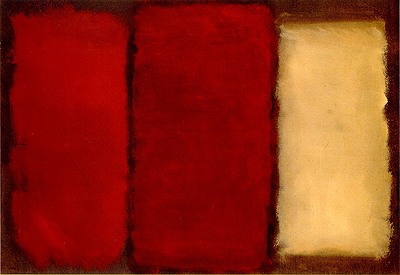
My disdain for Mark Rothko

As both an artist (not a very good one, but still) and an art history researcher I often come across artists that are exalted for their ground breaking work. Most of the time these artists should be recognized for what they do, other times I'm more than taken aback by what some people consider great. Mark Rothko is one of the latter, along with artists like Jackson Pollock and Lee Krasner.
So, Mark Rothko (1903-1970) was a latvian-born american painter and printmaker. Though classified as an abstract expressionist he labeled himself simply as an abstract painter. While I could delve into his childhood and travels, I sort want to jump right ahead to his work and influences. He developed his style around 1936 when he began writing a book, which ne never completed; about the similarities between the art of children and that of modern artists. While his ideas about how children draw and how we all start is accurate, as he continues to develope his ideas he seems to get more and more...outrageous. It is as if he is fishing for reasons to explain his own work. His most famous work is classified as color field painting. The characteristics of this genre of painting are as follows:
--large fields of expressive color
--non-objective
--simplified, essentialized compositions
--"subtle nuances"
--tragic subline; collective unconcious: collective unconcious was a theory developed by Carl Jung. It is based on his observation that there are universal symbols that are present across different cultures. These occur in dreams and myth to reveal a deep unconcious connection among all human beings.
He also abandoned the idea of naming his pieces. The first 3 characteristics I see, the other 2...well, I'll leave you to judge that for yourselves, but I believe they are empty words hes throwing out to give his work more meaning than it holds.
Here is the first example I have of his. We see 3 fields of color, 2 shades of red, one panel of a cream color, a rough brown border and dividing lines. This. Is. NOT. a great piece of art. Where are these mystical, "subtle nuances", where is the tragic subline or collective unconcious? I just see red.
Some might say I need to expand my mind, others say I don't understand. Well, the truth is I don't understand. While I will agree that his assesment that as children we first step into the art world by using color to express ourselves. I can remember taking crayons and scribbling vast panes of color all over the page. But from there I grew, we all grow and develope. I feel he is spitting in the face of all those artists who strived to create the masterpeices we all know and love today.


I will say his use of color is powerful....that is all I see. I just see fields of color, undeveloped and lacking any semblence imagination or passion.

Monday, November 23, 2009

Gods in Art: Saturn/Cronus

I became fixated on a particularly dark painting recently, or more re-fixated. This piece is Saturn Devouring his Son (1819) by Francisco de Goya. It made me consider the various ways the gods are represented in art. They are shown in a godly way, shown as all powerful and to be feared beings. And on the other side we can see them depicted as malicious beasts. To understand the meanings behind these various depictions we need to know the history and story of Saturn or Cronus.
In Roman mythology he is Saturn and n Greek mythology he is Cronus, not to be confused with Chronos; the personification of time. The story behind him is roughly the same in both cultures. He was the leader and the youngest of the first generation of the Titans. The Titans were the descendents of Gaia/Terra (goddess of the earth) and Uranus/Caelus (god of the sky). Saturn/Cronus was the god of agriculture, justice, and strength. He was the deity of the harvest and often it is attributed for him to be holding a sickle in his left hand and a bundle of wheat in his right.
Gaia/Terra asked for help from Saturn/Cronus because Uranus/Caelus was placing some of his children under the earth, as he hated them - mainly the children with the fifty heads. Saturn/Cronus waited for his father and castrated him with his sickle. Fro the blood sprang forth the Giants, a fourth race of monsters, and the Furies whose purpose was to punish the sinners. They are referred to as "those who walk in the darkness". Aphrodite/Venus emerged where the member was cast into the sea.
As he desposed of his father he became ruler of the universe. He reignd with her sister, Ops/Rhea, who he also married, One day it was prophesied that he would lose power when one his children would rise up and kill him. To prevent this from happening he would swallow each of his children following their birth. Upon the birth of their 6th child, Jupiter/Zeus; he was spirited away to the island of Crete and Ops/Rhea placed a stone in swaddling cothes and tricked him into swallowing it. As Jupiter/Zeus grew up he was taken care of and aided by his grandmother Gaia/Terra. Once he reached adulthood he secured a job as cup-bearer to Saturn/Cronus and gave him a potion that caused him to vomit up Saturn/Cronus's five siblings; Vestia/Hestia, Ceres/Demeter, Juno/Hera, Pluto/Hades, and Neptune/Poseidon.
This started a war that nearly destroyed the universe. It ended with Saturn/Cronus being defeated and him and his brother being imprisoned in Tatarus, a dark region at the end of the earth. Jupiter/Zeus then took the throne and ruled. Another myth ends with Saturn/Cronus fleeing to Rome and establishing the Golden Age.
The myth and legend behind Saturn/Cronus paints various pctures about him. First he seems caring by helping his mother and siblings with the murder of his father, but it seems as though it was done to though selfish means. Then he becomes monsterous as he devours his children. And there there is the possibilty of him becoming a great leader in Rome. These conflicting views sotimes lead to confusion in how to show him in art but each artist figures out he wants to exemplify this god.

This is Cronus and Rhea (475 - 425 BCE) attributte to the Nausicaa painter. It is painted on a greek vase. Here we see Rhea handing over the stone for Cronus to swallow. This trickery among the gods is not umcommon in legends and is often depicted in the art world, but this story is the most commonly reference one. There is another depiction done in a relief sculpture.
This is Kronos and Rhea (Kronos is another accepted spelling). Artist is unknown.
Rhea is considered somewhat of a heroine for this. Had he known what might have he done?
He isn't aways shown this way, he often shown on his own as well.
This is Saturnus (1546) by Caravaggio. It is a drawing and shows him as a god; strong and powerful. This is a piece where Cronus/Saturn is exalted and adored. It looks similar to many of the statues adorning the Temple of Saturn located at the western end of the Forum Romanum, the heart of the commerce for ancient Romans.
This place is often visited during the festival of Saturnalia in ancient Rome.
The most interesting of pieces depicting Saturn/Cronus are the ones showing him as the mosterous being I imagine him to
be. Here we see Saturn Devouring his Son (1819) by Francisco de Goya. I love that here he seems primative and horrific. He grasps he body and literally tears it limb from limb. The blood and he look on his face is captivating. There is some weaknes in him eventhough he is the one devouring his son. It is as if he is completely fueled by fear. His twisted body and wide eyes leave me feeling uncomfortable, but I can't look away.
All in all, no matter how he is shown the general feeling is always the same, one of fear and power.


Sunday, October 18, 2009

Chuck Close

This artist is contemporary and in a drawing class I took 2 years ago I became exraordinarily transfixed on him. He's an american painter born in 1940 who achieved incredible recognition through his massive-scale paintings and his work using photorealism and hyperreailsm. He is the amazing Chuck Close.

Photorealism is the genre of painting based on making a painting from a photograph; it began in the late 1960's. It eveolved from pop art as a reaction to Abstract Expressionism.

Hyperrealism is simply considered to be an advancement of photorealism. Hyperrealist painters and sculptors use photographic images as a reference source from which to create a more definitive and detailed rendering, one that unlike Photorealism, often is narrative and emotive in its depictions. Photorealist painters tended to imitate photographic images, often omitting or abstracting certain finite detail in order to maintain a consistent overall pictorial design.
Now, Cuck Close is a fascinating individual and his story powerful and sad. The beginning is semi-standard. He graduated Yale with an MFA and taught art at the University of Massachusetts. His first one-man show was at the New York Museum of Modern Art in 1970.
His work was innovative. I studied and observed and learned all about his technique. To create his grid work copies of photos, Close puts a grid on the photo and on the canvas and copies cell by cell. Typically, each square within the grid is filled with roughly executed regions of color (usually consisting of painted rings on a contrasting background) which give the cell a perceived 'average' hue which makes sense from a distance. His first tools for this included an airbrush, rags, razor blade, and an eraser mounted on a power drill. His first picture with this method was Big Self Portrait, a black and white enlargement of his face.
Just look at the amazing detail and handiwork. Its diffcult to imagine it isn't a photograph. His work is calculated and masterful. I mean this painting is 9ft x 7ft so I can only imagine how long it took, about 4 months apparently. He used acrylic paint and an airbrush to include every detail. This was the first of his large-scale works and he just got more outrageous and daring from this point.

This piece and detail is Mark (1978-1979). This one took him 14 months to complete, he used acyrlic paint and applied it in a series of airbrushed layers that basically imitated how printers work today. Just look at the size and the detail. I can't get over the level of skill. I'm just blown away.
Look at that iris! Its phenomenal and unprecedented.
He soon implemented another technique.
This one is Lucas (1986-1987).
Just as beautiful as the one before, but stylistically more interesting. It's quite reminscent of the "pixelated" look with overblown digital photographs, which makes this idea more than impressive. If you look close enough at the detail yuo can evn see the pencil lines. Some would say it's sloppy, but I find it charming.
I have tried to utilize this technique (feel free to give criticism):
It has no name since it as purely practice for me (2007).
I think I did a decent job at imitation, but my medium was oil pastels.

Close's story only gets more interesting from this point. On December 7, 1988 he went to New York to give an art award, but he felt a pain in his chest. He managed to give his speech and then he quickly ran to the hospital. By the time he had been admitted and examined he was paralyzed form he neck down and it turned out he had a rare spinal artery collapse. Close would, so intimately, call this day "The Event". Close was in rehab for several months strengthening his muscles; he soon had slight movement in his arms and could walk, yet only for a few steps. He has relied on a wheelchair since.
Close continued to paint on with a brush strapped onto his wrist with tape, creating large portraits in low-resolution grid squares created by an assistant. I can hardly fathom how difficult physically and emotionaly it had to be for him. He could no longer paint as meticulously as before and no longer could he achieve that very fine detail. His work was still beautiful and extraordinary.
He painted many people who are household names today. They include people like Bill Clinton, Kate Moss, Willem Dafoe, and Brad Pitt, along with his wife and children.
I strongly encourage anyone to view his work. Simply wonderful.
Here are some of his paintings, and you will be amazed:
Maggie (1996).
This is the one tried to imitate.


John (1971-1072).
Your mind was blown, right?


Eric (1990).

Color Theory

Color theory can be immensely complicated sometimes, but once you figure out one part of it the rest is easy to pick up on. The idea of subtractive color is what most painters use.
Subtractive color: where mixing the hues will create black.
Grasping this theory will help you understand many things like understanding why certain colors "work" together and others don't. Or how paintings are deigned, because color is a vital element of the comosition. Learning how to simply mix the colors will be better understood, you will better recognize the individual properties. And you will understand the basic principles of painting.
Start with color. Colors are classified by three properties: hue, purity and value. People tend to confuse the terms and misunderstand them. It should be known that colors will mix and appear differetly on a computer screen.

Hue: color (it really is that simple).

Purity: The freedom from other color admixtures.

Value: The luminance — brightness or dullness — of a hue, as measured by the amount of light reflected. Also called tone or tonal value.
To tint a color you would add white while a shade would be adding grey or the compliment of that color.
In order to understand how complimentary colors work you need to understand mixing colors as well as primary colors, scondary colors and tertiary colors.
The primary colors are red, yellow, and bue.
The secondary colors are the mixing of 2 rimary colors, orange, green and purple. Example - red plus yellow equals orange.
A secondary color mixed with an adjacent primary (on the color wheel) will create a tertiary color.
Colors also have a temperature. Colors are commonly described as warm or cold. Warm colors lie at the orange-red end of the spectrum, and are 'active', causing them to 'advance'. Blue colors, particularly when dark and/or undersaturated, are 'cool' and tend to 'recede'. Other areas of the spectrum remain neutral. I personally tend to have difficulty mixing colors and trying to get just the right teperature and if I want perfect color harmony I really need to get that down. I demand some sort of thermometer for paint.
There are a few approaches to having successful color harmony.

Monochrome
One hue. Composition is achieved entirely through adjusting purities and tones. A limited but powerful approach, that always makes a good exercise.
In this detail from his Diana and Callisto (1556-9. National Gallery of Scotland. Edinburgh), Titian has used a simple orange hue throughout, not far from that shown above in the color purity strip. The marvelous variety comes from modifying purity and tone with glazes and scumbles — which demonstrates the power of old master techniques. (The whole picture uses a wider color range, including blue and a pink-red.)

Complementary
Composition uses one hue and its complementary — e.g. blue and orange. The hues can be mixed in various proportions, and tones added with white or black (or preferably earth pigments).

The detail comes from a famous painting by Monet of the Beach at Trouville (1870). It was painted on the spot. Though seeming a careless, even clumsy, improvisatory sketch, it is nothing of the sort. Monet served a traditional apprenticeship, and is here playing off an orange in beach and flesh tones against chalky tints of blue.

Analogous.
Composition using just 3 hues of 12-color wheel - e.g. orange, orange-red and red. As before, the hues can be mixed, and their tones adjusted.
This scheme can be further divided into:
1. one pure hue and the other two semi-neutral (i.e. mixed, muddy, low intensity). The pure tone will advance more than the others, whether is warm or cold.
2. high key pure hues. Usually applied in a broken fashion so that hues of the same value shimmer when seen close to, but group to broad areas of color from a distance.
3. one dominant, one subordinate and one minor. The dominant is varied with different purities and values.
The detail is from Eugene Delacroix's Death of Sardanapolis. 1826. Musée du Louvre. Paris. The whole picture employs an analogous color scheme of red, red-orange and orange.

Split Complementary
Like analogous, but with the addition of the complementary of the mid-hue of the analogous range. A warm/cool balance is more easily introduced with this scheme.

This intimate painting by Mary Cassatt (The Bath. c. 1892. The Art Institute of Chicago) uses tertiary hues, and falls somewhere between a triadic scheme and a split complementary one of red-purple against hues of green-blue. The background repeats the foreground colors but in muddier and darker colors.

Triadic
Uses all three hues that are equidistance on color wheel. Hues may be varied in purity and tone as usual, and the scheme is further divided:

1. Primary colors only: very difficult to use outside posters and graphic design.
2. Secondary triadics, e.g. scarlet, mauve and viridian. Very beautiful effects can be achieved, probably because all colors contain some of the other two secondaries.
Green, blue and yellow appear in this detail from Vermeer's The Music Lesson (c. 1664. HM The Queen's Royal Collection. St. James's Palace). Harmony has also been achieved by very skillful use of tone.
I'm certain this wasn't exactly enlightening, but there no better way to learn other than reading and practicing. And I'm a compulsive note-taker....this blog is kind of enabling me.